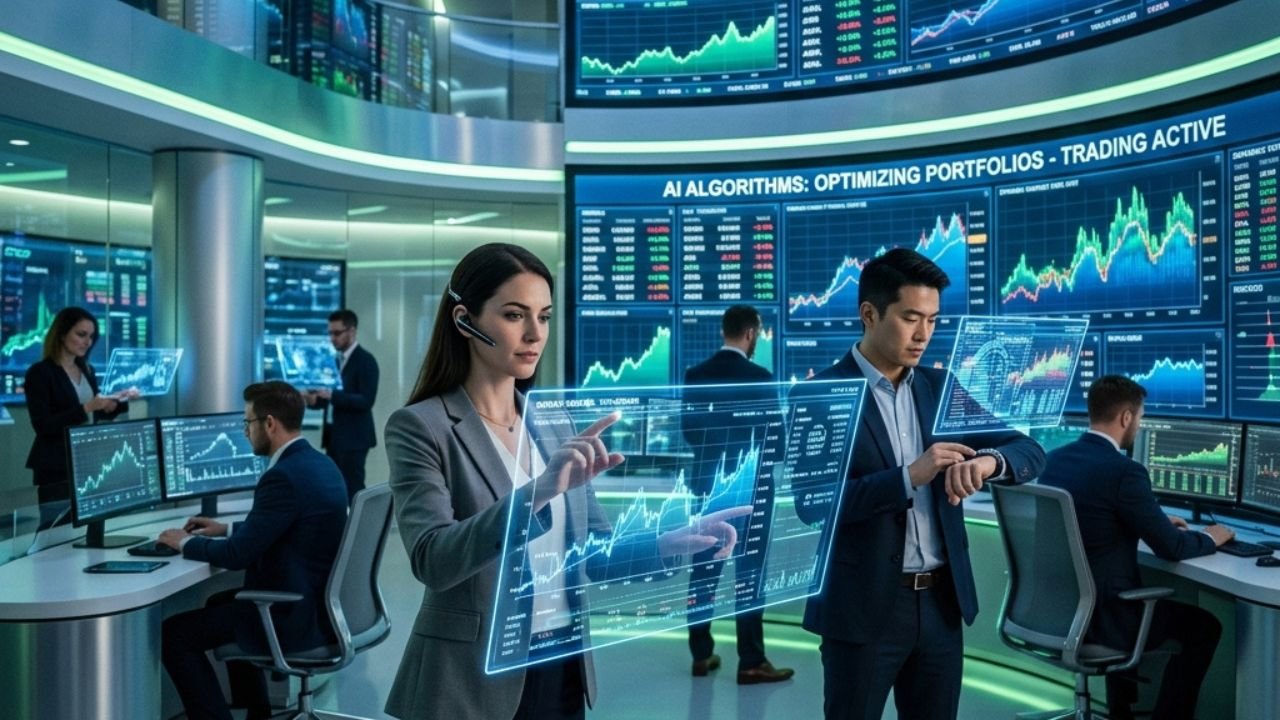
AI-powered investing uses machine learning algorithms and predictive analytics to analyze market data, automate trades, and reduce emotional decision-making in forex and stock markets. Institutions and retail traders alike are adopting AI tools to identify patterns faster, manage risk more effectively, and generate returns that traditional strategies struggle to match.
The numbers don’t lie. Global algorithmic trading accounts for 60–73% of all US equity trading volume, according to Select USA. And that figure is climbing—not because traders are becoming lazier, but because AI is genuinely becoming better at reading markets than humans are.
This isn’t a distant prediction. It’s the current reality reshaping how money moves through forex and stock markets every single day. Machine learning models can process millions of data points in milliseconds. Predictive analytics can identify trends before they become visible on a chart. Sentiment analysis can scan thousands of news articles and social media posts to gauge market mood in real time.
For traders and investors who understand how to harness these tools, the opportunity is substantial. For those who don’t, the risk of being outpaced is equally significant.
This post breaks down exactly how AI is transforming financial markets, which tools are leading the charge, how to get started, and what the future holds for AI-powered investing in forex and stock trading.
How Did AI Transform Financial Markets—And How Quickly?
To understand where AI investing stands today, it helps to trace how quickly it got here.
Algorithmic trading has existed since the 1970s, when the New York Stock Exchange introduced designated order turnaround systems to automate simple order execution. Through the 1980s and 90s, quantitative hedge funds like Renaissance Technologies began using statistical models to generate market-beating returns. These early systems were rule-based—fast, but rigid.
The real shift came with machine learning. Unlike rule-based algorithms, machine learning models can adapt. They learn from new data, update their assumptions, and refine their strategies without human intervention. By the 2010s, deep learning and neural networks were being deployed by major financial institutions to analyze complex, non-linear market patterns.
Then came generative AI. Tools built on large language models can now synthesize earnings calls, central bank speeches, geopolitical news, and social sentiment into actionable market signals—something no human analyst could do at the same scale or speed.
According to a 2023 survey by the CFA Institute, 60% of investment professionals reported using AI or machine learning tools in their investment process, up from just 10% five years prior. The adoption curve is steep, and it’s not slowing down.
Why Are Institutions Adopting AI-Powered Tools for Market Analysis?
The institutional case for AI investing comes down to three factors: speed, scale, and consistency.
Human traders are subject to cognitive bias, emotional fatigue, and information overload. An AI model has none of these limitations. It executes trades in microseconds, processes data across thousands of instruments simultaneously, and applies the same analytical framework whether markets are calm or in freefall.
For hedge funds and asset managers, this translates into a measurable edge. Firms like Two Sigma and Citadel have built their entire investment infrastructure around data science and machine learning. Two Sigma, which manages over $60 billion in assets, employs more data scientists and engineers than traditional financial analysts.
Beyond performance, AI also offers compliance benefits. Machine learning models create auditable decision trails, which help institutions meet increasingly stringent regulatory requirements around trade reporting and risk management.
Retail traders are now gaining access to the same category of tools—once reserved exclusively for institutional players—through platforms that have democratized AI-powered market analysis.
How Does AI Actually Work in Forex and Stock Market Trading?
What Is Machine Learning’s Role in Market Prediction?
Machine learning models trained on historical price data, volume, economic indicators, and alternative data sources can identify patterns that repeat across market cycles. In forex markets, these models are particularly effective at detecting currency pair correlations and macroeconomic relationships that drive exchange rate movements.
Supervised learning models—where the algorithm is trained on labeled historical outcomes—are commonly used for price direction classification. Reinforcement learning, a more advanced approach, trains AI agents to optimize trading strategies through trial and error in simulated market environments.
The critical advantage is adaptability. When market conditions shift—say, a central bank changes its monetary policy stance—a well-designed machine learning model can recalibrate faster than any human strategy could.
How Does AI Use Sentiment Analysis to Predict Market Moves?
Sentiment analysis applies natural language processing (NLP) to extract emotional signals from text data. In investing contexts, this means scanning earnings call transcripts, Federal Reserve statements, analyst reports, financial news, and social media platforms like Reddit and X (formerly Twitter) to gauge whether market sentiment is bullish, bearish, or neutral.
This approach proved particularly powerful during the GameStop short squeeze of 2021, when retail sentiment on social platforms drove price action that defied traditional valuation models. AI systems equipped with real-time sentiment analysis were better positioned to detect and respond to that momentum shift.
For forex traders, sentiment analysis of central bank communications—known as “Fed-watching” in US dollar pairs—provides critical signals ahead of rate decisions and policy shifts.
What Are the Main Types of AI Trading Strategies Used Today?
- High-frequency trading (HFT): AI executes thousands of trades per second, capturing small price inefficiencies across markets. Primarily institutional.
- Momentum-based strategies: AI identifies trending assets and rides directional moves, cutting positions when momentum reverses.
- Mean reversion strategies: AI detects when an asset has moved too far from its historical average and positions for a return to the mean.
- Arbitrage strategies: AI simultaneously exploits price discrepancies between correlated instruments or exchanges.
- Portfolio optimization: AI dynamically rebalances portfolios based on risk-adjusted return models, reducing drawdown while maximizing exposure to high-probability opportunities.
Which AI Tools Are Leading Traders and Investors Using in 2024?
The AI investing tool landscape has expanded rapidly. Here are the categories worth knowing:
AI-powered trading platforms: Tools like Trade Ideas and Tickeron offer AI-driven stock screeners, real-time alerts, and automated strategy backtesting for retail traders. For forex, platforms like MetaTrader 5 integrate AI-based expert advisors (EAs) that execute trades automatically based on predefined algorithms.
Predictive analytics platforms: Bloomberg Terminal’s AI-enhanced analytics and Refinitiv Eikon provide institutional-grade market intelligence. Retail-accessible alternatives include Danelfin, which uses AI to score individual stocks based on predictive probability of outperformance.
Sentiment analysis tools: Accern and MarketPsych aggregate news and social sentiment data into quantifiable signals. Some platforms integrate these directly into charting software.
Robo-advisors: Betterment and Wealthfront apply AI-driven portfolio management for long-term investors, automating rebalancing and tax-loss harvesting based on individual risk profiles.
Generative AI research tools: Platforms like Kensho (owned by S&P Global) use generative AI to answer complex financial questions and synthesize market research at scale. ChatGPT and similar large language models are increasingly used by retail investors for preliminary market research and strategy ideation—though they should not replace professional financial advice.
How Can Retail Traders Get Started With AI-Powered Investing?
The barrier to entry for AI investing has dropped dramatically. Here’s a practical framework:
Step 1: Define your trading style and time horizon. AI tools vary significantly in how they’re designed. A day trader focused on forex pairs needs different AI capabilities than a long-term equity investor optimizing a portfolio for retirement.
Step 2: Start with AI-assisted platforms, not full automation. Before deploying fully automated strategies, use AI tools in an advisory capacity—letting them surface signals and opportunities while you retain final execution control. This builds familiarity with how AI recommendations behave across different market conditions.
Step 3: Backtest rigorously before going live. Every AI-driven strategy should be backtested across multiple market cycles—bull markets, bear markets, and high-volatility periods—before risking real capital. Overfitting to recent historical data is one of the most common pitfalls in AI trading strategy development.
Step 4: Monitor model drift. AI models trained on historical data can degrade in performance as market dynamics evolve. Establish a review cadence to assess whether your AI tools are performing as expected and recalibrate when necessary.
Step 5: Manage risk explicitly. AI augments decision-making—it doesn’t eliminate risk. Always apply position sizing rules, stop-loss mechanisms, and diversification principles regardless of how confident an AI signal appears.
What Are the Risks of AI-Powered Investing?
AI investing carries specific risks that deserve clear-eyed assessment.
Overfitting: A model that performs brilliantly on historical data may fail in live markets because it has memorized past noise rather than learned genuine market signals.
Flash crashes: AI-driven trading can amplify volatility. The 2010 Flash Crash, during which the Dow Jones dropped nearly 1,000 points in minutes before recovering, was partly attributed to algorithmic trading feedback loops.
Data quality dependency: AI is only as good as the data it’s trained on. Garbage in, garbage out applies with particular force in financial markets, where data errors can compound into significant trading losses.
Regulatory uncertainty: Financial regulators in the US, EU, and UK are actively developing frameworks for AI in financial services. The SEC and CFTC have both signaled increased scrutiny of algorithmic trading practices, and compliance requirements may evolve significantly over the next few years.
Over-reliance: Treating AI signals as infallible is dangerous. AI models can and do make incorrect predictions, particularly in black swan events—sudden crises with no historical precedent.
The Road Ahead: What Does the Future of AI Investing Look Like?
Several trajectories are becoming clear.
Generative AI will play a larger role in investment research, synthesizing vast amounts of qualitative and quantitative information into structured insights. Multimodal AI—systems that process text, images, audio, and numerical data simultaneously—will enable richer market analysis than any single-modality approach.
Personalized AI investment models, trained on individual investor behavior and preferences, will challenge the one-size-fits-all approach of current robo-advisors. Real-time explainability—AI systems that can articulate why they generated a specific trading signal—will become a regulatory and commercial necessity.
The firms and individual traders who invest now in understanding AI tools will be significantly better positioned to adapt as the technology matures.
Separating Signal from Noise in AI-Powered Investing
AI is reshaping forex and stock market investing at a pace that leaves little room for complacency. The question for traders and investors is not whether AI will influence financial markets—it already does—but how to engage with it strategically and responsibly.
Start small. Learn the tools. Backtest everything. And never treat any model’s output as a substitute for sound risk management. The traders who will benefit most from AI-powered investing are those who use it as a precision instrument rather than a black box.
The edge is there. Capturing it requires both the right technology and the discipline to use it well.
Frequently Asked Questions About AI-Powered Investing
Is AI-powered investing suitable for beginner traders?
AI investing tools can benefit beginners, but they’re most effective when combined with foundational knowledge of how markets work. Beginners should start with AI-assisted platforms—where the AI surfaces signals but the trader makes final decisions—before progressing to automated strategies. Jumping straight to full automation without market understanding increases the risk of significant losses.
How accurate are AI trading algorithms in predicting market movements?
No AI algorithm predicts market movements with certainty. Accuracy rates vary widely depending on the model, the market conditions, and the time horizon. Most professional-grade AI trading systems aim to achieve a statistical edge over time—meaning they win more often than they lose—rather than targeting consistent directional accuracy on individual trades.
What is the difference between algorithmic trading and AI trading?
Algorithmic trading follows fixed, pre-programmed rules to execute trades automatically. AI trading uses machine learning models that can learn from new data, adapt to changing conditions, and improve over time without being explicitly reprogrammed. AI trading is a more advanced and flexible subset of algorithmic trading.
Can AI replace human traders and fund managers?
AI is augmenting human traders and fund managers rather than replacing them entirely. Functions that involve pattern recognition, data processing, and execution speed are increasingly automated. Functions that require judgment, client relationship management, and creative strategy development remain predominantly human—though AI is beginning to assist in these areas too.
What are the regulatory rules around AI trading in the US?
The SEC and CFTC both regulate algorithmic and AI-driven trading in the US. Firms using AI trading systems must comply with rules around market manipulation, best execution, and trade reporting. Regulatory requirements are evolving rapidly, and compliance frameworks for AI in financial services are expected to tighten significantly through 2025 and beyond. Always consult a qualified compliance professional before deploying AI trading strategies commercially.
Is it legal for retail investors to use AI trading bots?
Yes, retail investors can legally use AI trading bots in most jurisdictions, including the US. However, the tools must be used in compliance with the terms of service of the brokerage or exchange platform, and any automated strategy must adhere to applicable trading regulations. Some high-frequency and latency-sensitive strategies may require broker approval or specific account types.