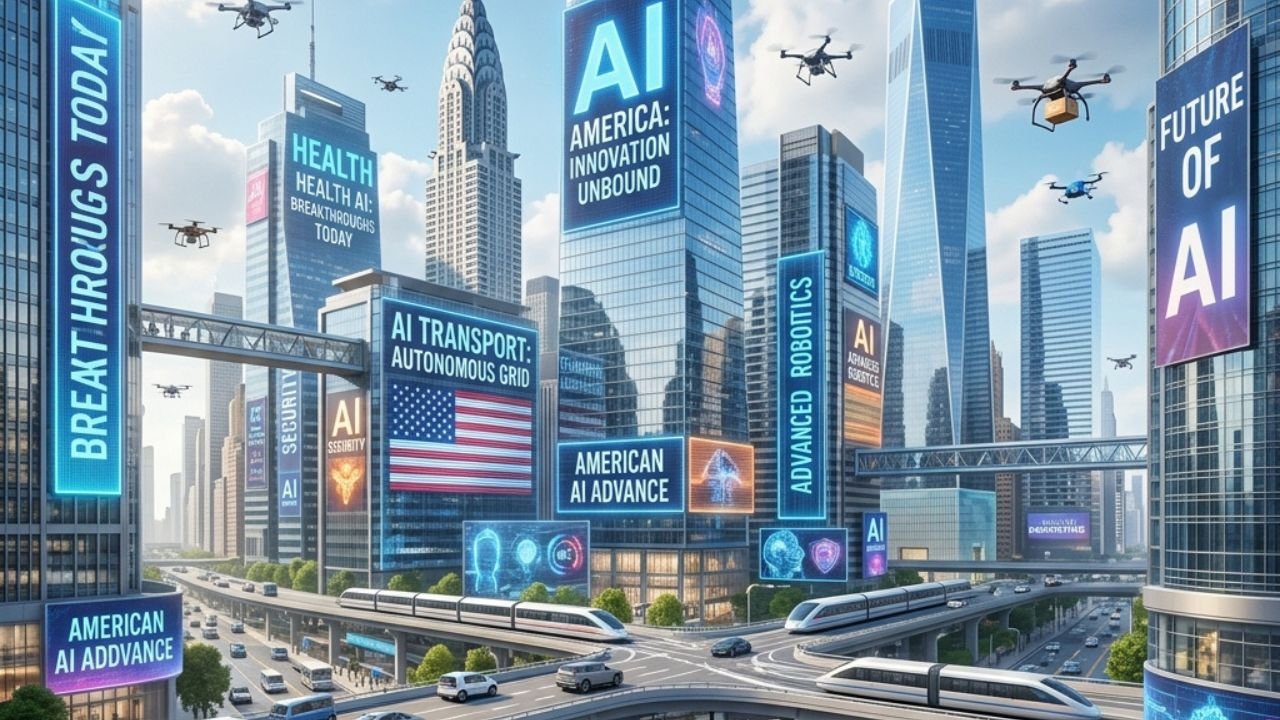
Artificial intelligence is reshaping the American economy, workforce, and everyday life at an unprecedented pace. From healthcare diagnostics to autonomous manufacturing, AI is projected to add trillions to U.S. GDP over the next decade—while simultaneously forcing businesses, workers, and policymakers to adapt faster than ever before.
Few technological shifts have moved this quickly. In less than a decade, artificial intelligence has gone from a niche research concept to a driving force behind some of America’s most consequential industries. Today, AI powers everything from fraud detection at major banks to personalized treatment plans at leading hospitals. And the pace isn’t slowing down—it’s accelerating.
For businesses, investors, and workers alike, understanding where AI is headed isn’t just interesting. It’s essential. The decisions made in the next few years—by companies, governments, and individuals—will determine who leads the AI economy and who gets left behind.
This post breaks down the current state of AI in America, its economic implications, the risks that come with rapid adoption, and the trends most likely to define the next decade of AI development in the United States.
What Is Artificial Intelligence, and Where Does It Stand in the U.S. Today?
Artificial intelligence refers to the development of computer systems capable of performing tasks that typically require human intelligence—things like recognizing speech, making decisions, translating languages, and identifying patterns in large datasets. Modern AI systems are primarily built on machine learning, a subset of AI where models learn from data rather than following explicitly programmed rules.
The United States currently leads the world in AI development. According to the Stanford AI Index Report 2024, the U.S. attracted more private AI investment than any other country—$67.2 billion in 2023 alone, representing nearly half of the global total. American companies like OpenAI, Google DeepMind, Anthropic, and Meta AI are setting the pace for foundation model development, while research institutions like MIT, Stanford, and Carnegie Mellon continue to produce groundbreaking academic work.
Adoption is accelerating across sectors. Healthcare systems are using AI to detect diseases earlier and with greater accuracy. Financial institutions are leveraging AI models to assess credit risk in real time. Manufacturers are deploying AI-powered robotics to optimize production lines. Retailers like Amazon have built AI recommendation engines that drive a significant portion of their revenue. The technology is no longer experimental—it’s operational, and it’s scaling.
What Are the Biggest Recent AI Breakthroughs Shaping the U.S. Landscape?
The last three years have produced a concentration of AI breakthroughs that would have seemed extraordinary just a decade ago.
Large language models (LLMs) represent perhaps the most visible leap. OpenAI’s GPT-4, Anthropic’s Claude, and Google’s Gemini have demonstrated that AI systems can engage in nuanced reasoning, write code, summarize complex documents, and produce creative content at a level of quality that rivals human output. These models are being integrated into enterprise software at a rapid clip—Microsoft’s Copilot, embedded in Office 365, is already used by millions of professionals daily.
Multimodal AI—systems that can process and generate text, images, audio, and video simultaneously—is another frontier that’s moving fast. OpenAI’s GPT-4o and Google’s Gemini 1.5 Pro both demonstrate strong multimodal capabilities, opening new applications in media, education, and design.
In healthcare specifically, AI models are making measurable clinical contributions. Google DeepMind’s AlphaFold revolutionized protein structure prediction, a discovery with profound implications for drug development. AI diagnostic tools are helping radiologists detect cancers that human eyes might miss, reducing error rates in some settings by up to 30%.
How Is AI Currently Being Used Across Key American Industries?
How is AI transforming American healthcare?
AI adoption in U.S. healthcare is advancing on multiple fronts. Diagnostic imaging tools powered by AI are helping clinicians detect conditions like diabetic retinopathy, lung cancer, and cardiovascular disease earlier and more accurately. Electronic health record (EHR) platforms are integrating AI to reduce administrative burden—one of the leading causes of physician burnout.
Predictive analytics tools are also allowing hospitals to anticipate patient deterioration before it becomes critical, enabling faster intervention. Companies like Tempus and PathAI are building data-driven platforms that personalize cancer treatment based on individual patient profiles, moving the industry closer to precision medicine at scale.
What role does AI play in American finance?
The financial services sector has been one of the earliest and most aggressive adopters of AI in the U.S. Banks and fintech companies use machine learning models to detect fraudulent transactions in milliseconds, approve or deny loan applications with greater consistency, and manage investment portfolios through algorithmic trading.
JPMorgan Chase, Goldman Sachs, and BlackRock have all made significant investments in proprietary AI capabilities. JPMorgan’s COiN platform, for example, reportedly reduced the time needed to review commercial loan agreements from 360,000 lawyer-hours annually to just seconds.
How are manufacturing and retail sectors using AI in America?
In manufacturing, AI-powered robotics and predictive maintenance systems are reducing downtime and improving output quality. General Motors, Ford, and Boeing are investing heavily in AI-driven automation that improves precision while lowering production costs.
Retail giants like Amazon and Walmart use AI across their entire supply chains—from demand forecasting to warehouse automation to last-mile delivery optimization. Amazon’s recommendation engine, driven by machine learning, is estimated to generate approximately 35% of the company’s total revenue.
What Is the Projected Economic Impact of AI on the United States?
The economic implications of AI for the U.S. are substantial. According to a McKinsey Global Institute report, AI could contribute between $13 trillion and $22 trillion to global GDP by 2030—with the United States positioned to capture a disproportionate share of that value, given its current lead in AI development and adoption.
Goldman Sachs has estimated that AI automation could raise U.S. productivity growth by approximately 1.5 percentage points annually over the next decade. For context, productivity growth in the U.S. averaged just 1.4% per year between 2005 and 2019—meaning AI has the potential to effectively double that figure.
How will AI affect American jobs and the labor market?
This is the question that draws the most attention—and the most anxiety. The honest answer is: it’s complicated.
AI will displace certain categories of work. The World Economic Forum’s Future of Jobs Report 2023 estimated that AI and automation could displace 85 million jobs globally by 2025, while simultaneously creating 97 million new roles better suited to a human-machine collaborative environment. In the U.S. specifically, roles involving repetitive data processing, basic customer service, and routine analysis face the greatest near-term risk.
However, displacement doesn’t equal destruction. Historical precedent suggests that major technological transitions—the industrial revolution, the rise of computing, the internet era—ultimately created more jobs than they eliminated, even as they required significant workforce adaptation.
The key variable is reskilling. Workers who develop the ability to collaborate with AI tools, interpret AI outputs, and apply human judgment to AI-assisted processes will be in high demand. This puts significant pressure on American educational institutions and employer training programs to evolve quickly.
What Are the Key Ethical and Regulatory Challenges Facing AI in America?
Rapid AI advancement brings legitimate concerns that the U.S. is only beginning to address through formal policy frameworks.
Algorithmic bias remains a serious issue. AI systems trained on historical data can perpetuate and even amplify existing inequalities—in hiring, lending, healthcare, and criminal justice. Without deliberate intervention in how models are designed and audited, these biases become embedded in critical decision-making systems at scale.
Privacy and data use is another pressing concern. AI systems require vast amounts of data to function effectively, and the collection, storage, and use of that data raises significant questions about surveillance, consent, and individual rights.
On the regulatory front, the Biden administration’s Executive Order on Safe, Secure, and Trustworthy AI, issued in October 2023, marked a significant step toward federal oversight. The order established requirements for AI safety testing, transparency obligations for AI developers, and new standards for AI use in government. However, comprehensive federal AI legislation—similar to the EU’s AI Act—has yet to pass in the United States.
The regulatory environment is evolving, and businesses operating in this space should expect increasing compliance requirements over the next several years.
What Are the Most Important AI Trends to Watch in America Over the Next Decade?
Several trends are likely to define the trajectory of AI in the United States through 2035:
- AI agents and autonomous systems: The shift from AI tools that respond to prompts toward AI agents that take independent sequences of actions is already underway. Agentic AI—capable of browsing the web, writing code, sending emails, and completing multi-step tasks without human intervention—will fundamentally change how knowledge work is organized.
- AI in national security and defense: The U.S. Department of Defense has made AI a strategic priority. Applications include autonomous surveillance systems, logistics optimization, and cybersecurity threat detection. The competition between the U.S. and China for AI supremacy has clear national security dimensions.
- Edge AI and on-device processing: As AI models become more efficient, they are increasingly running on local devices rather than cloud servers—enabling real-time AI in environments where latency and privacy are paramount, from medical devices to autonomous vehicles.
- Scientific AI and research acceleration: AI is becoming a core tool in scientific discovery. From climate modeling to materials science to drug discovery, AI systems are compressing research timelines that once took decades into years—or even months.
Where Does America Go from Here?
The United States enters the next phase of the AI era with real advantages: the world’s leading AI companies, the deepest talent pool, the most active private investment ecosystem, and a culture of technological innovation that has a proven track record. Those are genuine strengths.
But sustaining that lead requires deliberate choices. Investment in AI education and workforce development will determine whether the economic gains of AI are broadly shared or concentrated among a narrow group of technology companies. Regulatory frameworks will shape whether AI deployment in America is trustworthy and equitable, or chaotic and harmful. And strategic alignment between government, industry, and academia will determine whether the United States continues to set the pace—or cedes ground to competitors.
AI is not a distant future scenario. It’s the operating environment American businesses and workers are navigating right now. The organizations and individuals who treat it as such—studying it, adapting to it, and building with it—will be best positioned for what comes next.
Frequently Asked Questions About the Future of AI in America
What industries are most affected by AI in the United States?
Healthcare, finance, manufacturing, and retail are currently experiencing the deepest AI integration in the U.S. Each sector is using AI differently—healthcare for diagnostics and personalization, finance for risk assessment and fraud detection, manufacturing for automation and predictive maintenance, and retail for demand forecasting and recommendation engines.
Will AI replace American jobs?
AI will automate certain tasks and displace some roles, particularly those involving repetitive data processing or routine analysis. However, most economists and researchers expect AI to create new categories of work while transforming existing ones. Workers who develop AI collaboration skills will be better positioned than those who don’t.
What is the U.S. government doing to regulate AI?
The Biden administration issued an Executive Order on AI safety and oversight in October 2023, establishing federal guidelines for AI testing and transparency. Comprehensive federal AI legislation has not yet passed, but regulatory activity is increasing. Businesses should monitor developments closely, as compliance requirements are likely to expand.
How much will AI contribute to the U.S. economy?
Estimates vary, but Goldman Sachs projects that AI could raise U.S. productivity growth by approximately 1.5 percentage points per year over the next decade. McKinsey estimates AI could contribute between $13 trillion and $22 trillion to global GDP by 2030, with the U.S. positioned to capture a significant share.
Which American companies are leading AI development?
OpenAI, Google DeepMind, Anthropic, Meta AI, Microsoft, and NVIDIA are among the leading U.S. organizations driving AI development. Research institutions including MIT, Stanford, and Carnegie Mellon also play a central role in foundational AI research.