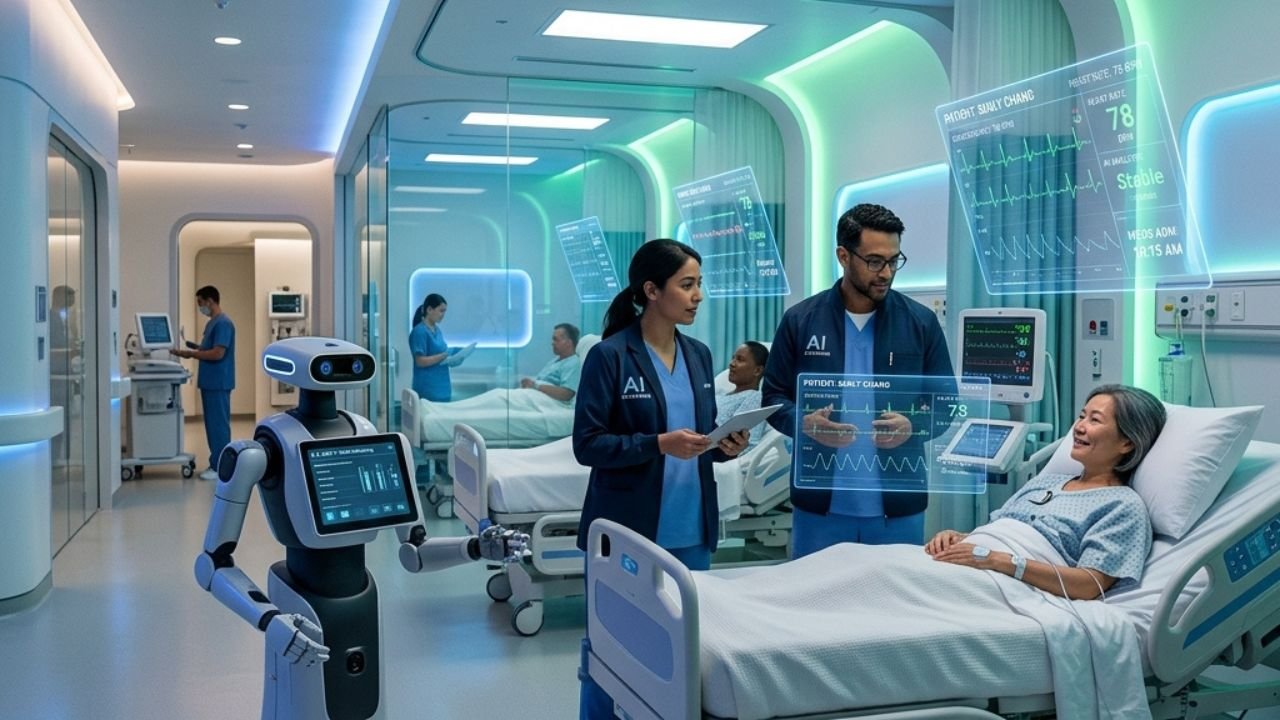
Smart hospitals in the USA use AI, automation, and digital technology to improve patient outcomes, streamline operations, and reduce costs. Key tools include EHR systems, diagnostic AI, predictive analytics, and robotic surgery. While adoption barriers remain, the shift toward AI-driven healthcare is accelerating rapidly across American health systems.
American hospitals are under pressure. An aging population, rising chronic disease rates, staffing shortages, and growing patient expectations have pushed healthcare providers to rethink how care is delivered. The answer, for a growing number of health systems, is the smart hospital—a digitally integrated facility where AI, automation, and data work in concert to improve outcomes and efficiency.
Smart hospitals go beyond simply installing new software. They represent a fundamental shift in how clinical decisions are made, how resources are allocated, and how patients experience care. From AI-powered diagnostic tools that detect cancer earlier than human radiologists, to predictive analytics that flag at-risk patients before a crisis occurs, the technology reshaping American hospitals is no longer experimental. It’s operational.
This blog post breaks down what smart hospitals look like today, where they’re headed, and what healthcare leaders, policymakers, and patients need to understand about this transformation.
What Does a Smart Hospital Actually Look Like in 2024?
The term “smart hospital” gets used loosely, but at its core, a smart hospital is one that integrates digital technologies—AI, IoT, robotics, and cloud computing—into both clinical and operational workflows.
Several American health systems are already leading the way. Mayo Clinic has partnered with Google Cloud to build AI-driven clinical intelligence tools that help physicians identify disease patterns across millions of patient records. Cleveland Clinic and IBM Watson have collaborated on AI research to identify new drug candidates. Cedars-Sinai Medical Center developed its own AI platform to predict patient deterioration and reduce ICU transfers.
The foundational infrastructure of a smart hospital typically includes:
- Electronic Health Records (EHRs): Systems like Epic and Cerner serve as the digital backbone, centralizing patient data and enabling AI tools to draw insights from it.
- Diagnostic imaging AI: Algorithms trained on millions of medical images can detect abnormalities in X-rays, MRIs, and CT scans with accuracy that rivals—and sometimes surpasses—specialist physicians.
- Predictive analytics: Platforms that analyze patient vitals, lab results, and behavioral data in real time to identify early warning signs of sepsis, cardiac events, or readmission risk.
The common thread across all of these technologies is data. Smart hospitals don’t just collect more of it—they make it actionable.
How AI Is Improving Diagnostic Accuracy and Speed
Diagnostic error affects an estimated 12 million Americans each year, according to research published in BMJ Quality & Safety. AI is emerging as one of the most promising tools to reduce that number.
Machine learning models trained on large imaging datasets can identify conditions like diabetic retinopathy, lung nodules, and skin cancer at rates that match or exceed expert clinicians. Google’s DeepMind developed an AI system capable of diagnosing over 50 eye diseases with accuracy comparable to world-leading ophthalmologists. FDA-cleared diagnostic AI tools are now deployed across radiology, pathology, and cardiology departments in hospitals nationwide.
Beyond diagnosis, AI is accelerating drug discovery. Platforms like Insilico Medicine and Recursion Pharmaceuticals use generative AI to identify novel drug candidates in a fraction of the time traditional pharmaceutical research requires. For patients with rare diseases or treatment-resistant conditions, this acceleration can be life-changing.
AI also enables more personalized treatment planning. By analyzing a patient’s genetic data, medical history, lifestyle factors, and treatment response, AI systems can recommend therapies tailored to that individual—a shift from the one-size-fits-all model that has historically defined medicine.
Streamlining Hospital Operations With Automation
Clinical care gets most of the attention, but some of AI’s most immediate value in hospitals lies in the back office.
Administrative tasks—scheduling, billing, prior authorization, documentation—consume a staggering share of physician time. According to a 2022 report by the American Medical Association, physicians spend nearly two hours on administrative work for every hour of direct patient care. AI-powered tools like ambient clinical documentation (which automatically transcribes and structures patient encounters) are reclaiming that time.
On the surgical floor, robotic-assisted surgery platforms like the da Vinci Surgical System have performed over 10 million procedures worldwide. These systems enhance surgeon precision, reduce complication rates, and shorten recovery times—particularly in minimally invasive procedures.
Supply chain optimization is another area where AI delivers measurable returns. Hospitals lose billions of dollars annually to expired medications, overstocked inventory, and inefficient procurement. AI-driven supply chain tools predict demand, automate reordering, and reduce waste—freeing capital that can be redirected to patient care.
What Are the Biggest Data Security and Privacy Risks in Smart Hospitals?
Greater connectivity brings greater risk. Smart hospitals generate and transmit vast quantities of sensitive patient data, making them attractive targets for cybercriminals. Healthcare was the most breached industry in the United States for the 13th consecutive year in 2023, according to IBM’s Cost of a Data Breach Report, with the average healthcare breach costing $10.93 million.
HIPAA compliance remains the regulatory baseline, but it was designed for a pre-AI era. Health systems now face the challenge of applying decades-old privacy frameworks to technologies that didn’t exist when those rules were written. AI models trained on patient data, for example, raise complex questions about data consent, de-identification, and secondary use.
Balancing innovation with privacy requires proactive governance—not just technical safeguards, but clear policies on how AI systems access, store, and use patient information. Federated learning (where AI models train on data without it ever leaving individual hospital systems) is one promising approach to maintaining privacy without sacrificing analytical power.
How Smart Hospitals Are Improving the Patient Experience
The patient experience inside a smart hospital looks markedly different from a conventional one. Telemedicine platforms, accelerated by the COVID-19 pandemic, now allow patients to consult with specialists regardless of geography. Remote patient monitoring devices—wearables that track heart rate, glucose, oxygen levels, and more—extend the hospital’s reach into the patient’s home, enabling earlier intervention and reducing emergency admissions.
AI-powered patient portals personalize communication, sending appointment reminders, medication instructions, and follow-up surveys tailored to each individual’s care journey. Chatbots handle routine inquiries around the clock, reducing wait times and administrative burden.
For underserved communities, these technologies hold particular promise. Telehealth eliminates transportation barriers for rural patients. Translation AI helps bridge language gaps in multilingual urban communities. Predictive tools can identify patients at high social risk—those with housing insecurity, limited food access, or transportation challenges—so care teams can connect them with support services before a health crisis emerges.
The Financial Case for Smart Hospital Investment
Healthcare executives rightly scrutinize the ROI on large technology investments. The evidence, increasingly, supports the business case for smart hospital adoption.
A 2023 analysis by McKinsey & Company estimated that AI could generate between $150 billion and $360 billion in annual savings across the US healthcare system by 2026 through efficiency gains, improved preventive care, and reduced clinical variation. Hospitals that have implemented AI-driven early warning systems for sepsis have reported reductions in mortality rates and ICU stays—outcomes that translate directly to lower costs and shorter lengths of stay.
Insurance coverage and reimbursement for AI-enabled services remain uneven, but momentum is building. The Centers for Medicare & Medicaid Services (CMS) has begun creating billing codes for certain AI-assisted services, signaling growing recognition that these tools constitute billable clinical value.
What Are the Main Barriers to Smart Hospital Adoption?
Despite the promise, widespread adoption faces real obstacles.
Implementation costs are significant. Deploying an enterprise-wide AI infrastructure requires capital investment in hardware, software, integration, and staff training that many smaller or rural hospitals simply don’t have access to.
Workforce resistance is another friction point. Clinicians who have practiced for decades sometimes view AI tools with skepticism—and not without reason. Concerns about algorithmic bias, liability, and the erosion of clinical judgment are legitimate and deserve serious engagement, not dismissal.
Interoperability remains one of the field’s most stubborn technical challenges. American healthcare runs on a fragmented patchwork of EHR systems, imaging platforms, and administrative tools that often can’t communicate with each other. AI is only as good as the data it can access; siloed systems limit its potential.
Solving these challenges requires coordinated effort across health systems, technology vendors, regulators, and payers—not just individual hospital initiatives.
What’s Next: Emerging Trends in Smart Hospital Technology
Looking ahead, several developments are set to reshape the smart hospital landscape further.
Predictive and preventive medicine will become more sophisticated as AI models incorporate genomic data, environmental factors, and behavioral patterns into risk assessments. The goal shifts from treating disease to preventing it.
Wearables and IoT integration will deepen the connection between hospital care and daily life. Continuous monitoring devices will feed real-time data into hospital systems, enabling care teams to intervene earlier and more precisely.
Regulatory evolution is already underway. The FDA’s Digital Health Center of Excellence is developing updated frameworks for AI-driven medical devices. As standards mature, health systems will have clearer guidance on validation, transparency, and accountability for AI tools in clinical settings.
The Road Ahead for American Healthcare
Smart hospitals are not a distant vision—they are being built right now, across the United States, in systems large and small. The technologies driving this transformation have moved from research labs into operating rooms, emergency departments, and patients’ living rooms.
The challenge ahead is not technological. It’s human. Successfully implementing smart hospital capabilities requires health systems to invest not just in software, but in people—training clinicians to work alongside AI, building governance structures that protect patient privacy, and ensuring that the benefits of digital innovation reach every community, not just the well-resourced ones.
For healthcare leaders, the question is no longer whether to engage with AI and digital transformation. The question is how quickly they can do it responsibly. The institutions that answer that question well will define American healthcare for the next generation.
Frequently Asked Questions About Smart Hospitals in the USA
What is a smart hospital?
A smart hospital is a healthcare facility that integrates AI, automation, IoT, and digital technologies into both clinical and operational workflows. The goal is to improve patient outcomes, enhance efficiency, and reduce costs by making data-driven decisions across every aspect of hospital operations.
Which US hospitals are leading in smart hospital technology?
Mayo Clinic, Cleveland Clinic, and Cedars-Sinai Medical Center are among the most recognized leaders in AI and digital healthcare adoption in the United States, with partnerships spanning Google Cloud, IBM Watson, and proprietary AI platforms.
How does AI improve patient safety in hospitals?
AI improves patient safety by detecting early warning signs of deterioration, reducing diagnostic errors, flagging medication conflicts, and enabling faster responses to critical changes in patient condition. Predictive analytics platforms are particularly effective at reducing sepsis mortality and preventable ICU admissions.
Is patient data safe in AI-powered hospitals?
Patient data security depends on the governance and cybersecurity practices of individual health systems. Healthcare remains the most frequently breached industry in the US, so robust safeguards—including encryption, access controls, and privacy-preserving AI techniques like federated learning—are essential.
What does AI-driven healthcare mean for patients with limited access to care?
AI-driven tools like telemedicine, remote monitoring, and translation AI can significantly improve healthcare access for rural, elderly, and multilingual populations who face geographic, physical, or language barriers to traditional in-person care.
How much can smart hospital technology save US healthcare?
According to a 2023 McKinsey & Company analysis, AI could generate between $150 billion and $360 billion in annual savings for the US healthcare system by 2026, primarily through efficiency gains, preventive care improvements, and reduced clinical variation.