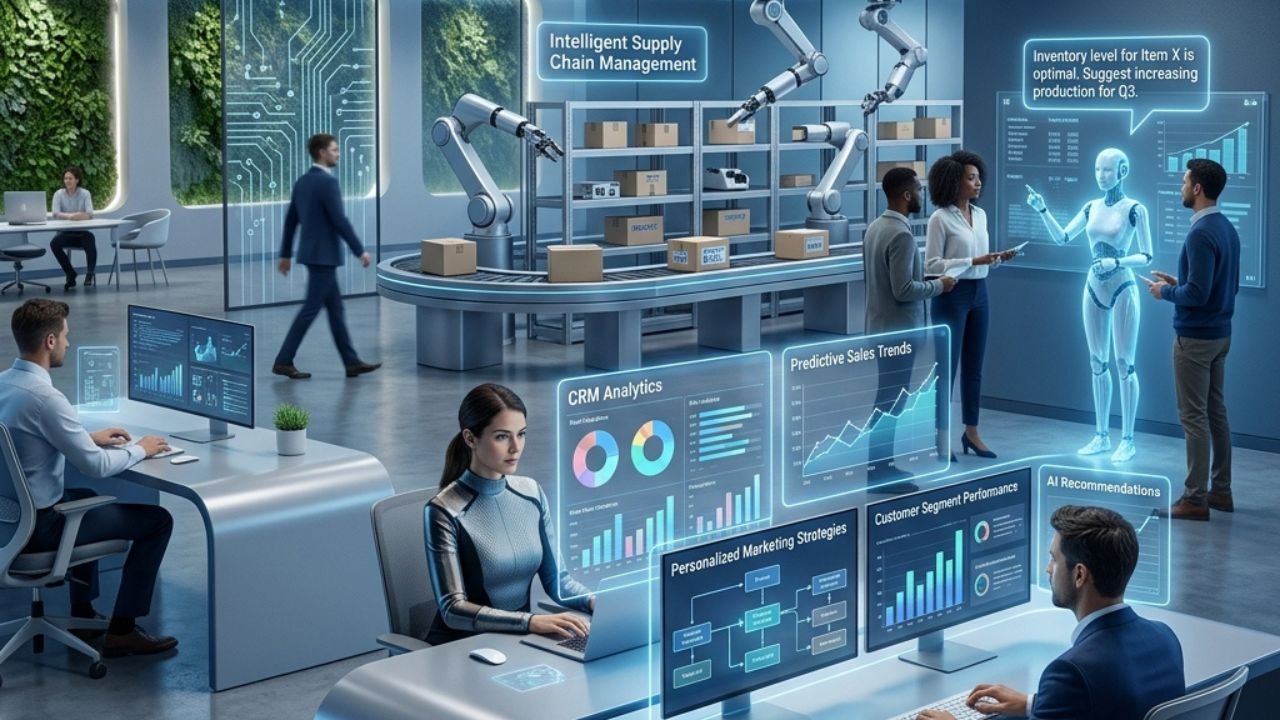
AI tools for business growth span marketing, operations, customer service, and HR. Companies that implement AI strategically—starting with a clear needs assessment and pilot programs—consistently report faster decision-making, lower costs, and stronger customer experiences. This guide covers the top tools, how to implement them, and what to watch out for.
The numbers are hard to ignore. According to McKinsey’s 2023 State of AI report, 55% of organizations have adopted AI in at least one business function—up from 50% the year prior. Yet many business leaders still feel unsure about where AI fits into their operations, which tools are worth investing in, and how to get started without disrupting what already works.
This guide cuts through the noise. It covers the most impactful AI tools across core business functions, walks through a practical implementation framework, and addresses the real challenges—bias, privacy, job displacement—that any responsible business leader needs to consider.
Artificial intelligence, in the business context, refers to software systems that can perform tasks typically requiring human intelligence: recognizing patterns, making predictions, processing language, and automating decisions. The distinction between “AI” and “automation” matters here. Traditional automation follows fixed rules. AI learns, adapts, and improves over time based on data.
That difference is what makes AI a genuine growth lever—and not just a cost-cutting tool.
How AI Tools Are Transforming Core Business Functions
What Are the Best AI Tools for Marketing and Sales?
Marketing and sales were among the first business functions to feel AI’s impact, largely because of how much data they generate.
CRM platforms with AI capabilities, like Salesforce Einstein and HubSpot’s AI features, can predict which leads are most likely to convert, flag at-risk customers before they churn, and recommend the next best action for sales reps. This reduces guesswork and helps teams focus their energy where it counts.
Predictive analytics tools, such as 6sense and Demandbase, analyze behavioral signals across the web to identify potential buyers before they even raise their hand. For B2B companies with long sales cycles, this kind of intelligence is invaluable.
Personalized marketing platforms like Adobe Experience Cloud and Klaviyo use AI to tailor content, email sequences, and product recommendations to individual users at scale—something that would be impossible to do manually across thousands of customers.
The result? According to Salesforce’s State of Marketing report, high-performing marketing teams are 2.5 times more likely to use AI than underperformers.
How Is AI Being Used in Business Operations?
Operational efficiency is where AI often delivers the most measurable ROI—particularly in supply chain management, manufacturing, and quality control.
Supply chain optimization tools like Blue Yonder and o9 Solutions use machine learning to forecast demand, manage inventory levels, and flag supply disruptions before they escalate. During the global supply chain crisis of 2021–2022, companies using AI-driven forecasting were significantly better positioned to respond quickly.
Process automation platforms, including UiPath and Automation Anywhere, handle repetitive back-office tasks—data entry, invoice processing, compliance checks—freeing up human staff for higher-value work.
AI-powered quality control is gaining ground in manufacturing, where computer vision systems can detect product defects at speeds and accuracy levels no human inspector can match. Companies like Landing AI have built platforms specifically for this use case.
What AI Tools Are Most Effective for Customer Service?
Customer expectations have shifted. According to Zendesk’s 2023 Customer Experience Trends Report, 72% of customers expect immediate service when they contact a company. AI is the most scalable way to meet that expectation.
AI chatbots, such as those built on platforms like Intercom, Drift, or Zendesk AI, handle common queries around the clock—reducing wait times and deflecting tickets that would otherwise require human agents.
Virtual assistants powered by large language models (LLMs) go a step further, handling nuanced conversations, processing returns, and escalating complex issues to the right human agent with full context already attached.
Sentiment analysis tools, like those offered by Medallia and Qualtrics, scan customer feedback—across emails, reviews, chat transcripts, and social media—to identify emerging issues and measure brand perception in near real-time.
How Are Companies Using AI for HR and Recruitment?
Hiring is time-consuming, expensive, and prone to human bias. AI is changing that—though it introduces its own bias risks (more on that shortly).
AI-powered hiring platforms like Greenhouse, Eightfold.ai, and Pymetrics use machine learning to match candidates with roles based on skills, experience, and predictive fit scores. Eightfold.ai, for example, analyzes millions of career trajectories to identify candidates who might be overlooked by traditional keyword-based resume screening.
Employee engagement platforms like Lattice and Leapsome incorporate AI to surface patterns in feedback data, flag flight risks, and recommend personalized development paths—helping managers act proactively rather than reactively.
How to Implement AI in Your Business: A Step-by-Step Guide
Step 1: Conduct a Needs Assessment
Before evaluating any tools, identify where the bottlenecks are. Ask: which processes are most repetitive? Where is decision-making slowest? Where does the business lose the most time or money?
Map these pain points to potential AI use cases. The goal is to find high-impact, low-disruption starting points—areas where AI can deliver quick wins without requiring a complete overhaul of existing systems.
Step 2: Run a Pilot Program
Resist the temptation to roll out AI across the entire organization at once. Instead, choose one business function and one tool. Set clear success metrics before launch—cost savings, time saved, customer satisfaction scores—and give the pilot 60 to 90 days to generate meaningful data.
Involve the team members who will actually use the tool. Their feedback is essential to understanding whether the solution fits the workflow or creates friction.
Step 3: Scale What Works
Once a pilot proves its value, build a roadmap for broader implementation. This includes staff training, integration with existing software systems, and a governance framework for how AI-generated outputs will be reviewed and acted on.
Scaling AI is rarely a one-time project. Plan for ongoing iteration as the tools improve and business needs evolve.
What Are the Biggest Challenges and Ethical Considerations of AI in Business?
Data Privacy and Security
AI systems are only as good as the data they’re trained on—and that data often includes sensitive customer or employee information. Businesses must ensure that AI tools comply with applicable data protection regulations, such as GDPR in Europe and CCPA in California.
Before deploying any AI platform, ask vendors: Where is data stored? Who can access it? How is it used to train models?
Algorithmic Bias
AI models can inherit and amplify biases present in historical data. In recruitment, for example, an AI trained on past hiring decisions may systematically disadvantage certain demographic groups. Amazon famously scrapped an AI recruiting tool in 2018 after discovering it penalized resumes that included the word “women’s.”
Regular audits of AI outputs—particularly in high-stakes decisions like hiring or lending—are essential.
Job Displacement
AI will change the nature of work. Some roles will be automated; new ones will emerge. Businesses that invest in reskilling and upskilling their workforce alongside AI adoption are better positioned to retain talent and manage the transition responsibly.
Real-World Success Stories: Businesses Growing with AI
Starbucks uses its Deep Brew AI platform to personalize product recommendations in its mobile app, optimize staff scheduling, and manage inventory across thousands of locations. The company credits AI with improving customer satisfaction scores and reducing operational costs.
Unilever implemented AI-driven video interview tools in its recruitment process, cutting time-to-hire by 75% while increasing candidate diversity—a notable example of AI being used to reduce rather than amplify bias.
Spotify uses machine learning extensively—most visibly in its Discover Weekly feature, which generates personalized playlists for over 600 million users. The feature has become one of Spotify’s strongest user retention tools.
These aren’t outliers. They’re early signals of what becomes standard practice as AI matures.
What Are the Emerging AI Trends That Will Shape Business Growth?
Several technologies on the near horizon will expand what’s possible for businesses of all sizes.
Generative AI is already transforming content creation, code generation, and product design. Platforms like Jasper and GitHub Copilot are enabling small teams to produce at the scale and speed that previously required much larger resources.
Multimodal AI—systems that process text, images, audio, and video simultaneously—will unlock new applications in product design, customer support, and market research.
AI agents, which can autonomously plan and execute multi-step tasks, represent the next frontier. Early versions are already being used to automate complex workflows in finance and legal services.
The businesses that thrive will be those that view AI adoption as an ongoing capability—not a one-time implementation project.
Start Small, Think Big
AI tools for business growth are no longer reserved for enterprise organizations with massive technology budgets. The barrier to entry has dropped dramatically, and the variety of tools available means businesses can start with a single, targeted use case and build from there.
The key is to start with a clear problem, choose a tool that solves it specifically, measure the results honestly, and expand from a foundation of evidence. That approach—methodical, data-driven, and human-centered—is what separates businesses that get lasting value from AI from those that treat it as a trend to chase.
The growth potential is real. The tools exist. The next step is yours.
Frequently Asked Questions
What is the best AI tool for small business growth?
There’s no single best tool—the right choice depends on your biggest pain point. For marketing, HubSpot’s AI features offer strong value at accessible price points. For customer service, Intercom and Zendesk AI are widely used and easy to implement. Start with one function and one problem before expanding.
How much does it cost to implement AI tools in a business?
Costs vary widely. Some AI tools—like basic chatbot builders or AI writing assistants—start at under $50/month. Enterprise platforms for supply chain optimization or predictive analytics can cost tens of thousands of dollars annually. Most vendors offer tiered pricing, so starting small is financially feasible for most businesses.
How long does it take to see ROI from AI implementation?
Most businesses see measurable results from a well-scoped AI pilot within 60 to 90 days. Broader organizational transformation typically takes 12 to 18 months, depending on the complexity of integration and the scale of change management required.
Is AI implementation risky for small businesses?
The risks—data privacy issues, algorithmic bias, integration failures—are real but manageable. Starting with reputable, established vendors, reviewing their data practices, and running controlled pilots significantly reduces exposure. The bigger risk for most small businesses is falling behind competitors who are already adopting AI.
What jobs are most at risk from AI in business?
Roles involving repetitive, rule-based tasks—data entry, basic customer support, invoice processing—face the highest displacement risk. Roles requiring creativity, complex judgment, and interpersonal skills are more resilient. Investing in workforce reskilling, particularly in data literacy and AI tool proficiency, helps employees remain competitive.